
Trusted by enterprise security teams
PwC Trustwave Teachers Mutual Bank Swire Shipping Defense.com

Protect clients from leaked company data

  • Breachsense monitors dark web sources continuously and indexes new stealer logs (passwords and cookies that malware steals from infected devices) within hours. Our sources include criminal marketplaces, hacker forums, Telegram channels and ransomware leak sites. We also find passwords that employees typed into phishing pages.
  • Each record shows when we found it and where it came from, such as the breach or file name. You can search our data for any client at any time.
  • Set up continuous monitoring for each client’s domains, email addresses and IP addresses. You can also monitor search terms, such as the company name or an executive’s name, which we look for in leaked files. We send alerts by email or by webhook. A webhook posts each alert to a URL in your PSA, SIEM (security information and event management) or client portal.
  • Query our API endpoints to retrieve all historical data about any client asset. Connect the results to your SIEM or SOAR (security orchestration, automation and response) tool through our integrations.
  • Our alerts include the plaintext password when the leak contains it or we can crack the password hash. Your tools can check whether the client’s employee still uses that password before forcing a reset.

Multi-Client Dark Web Monitoring Built for MSPs

Watchlists That Cover Every Client Domain

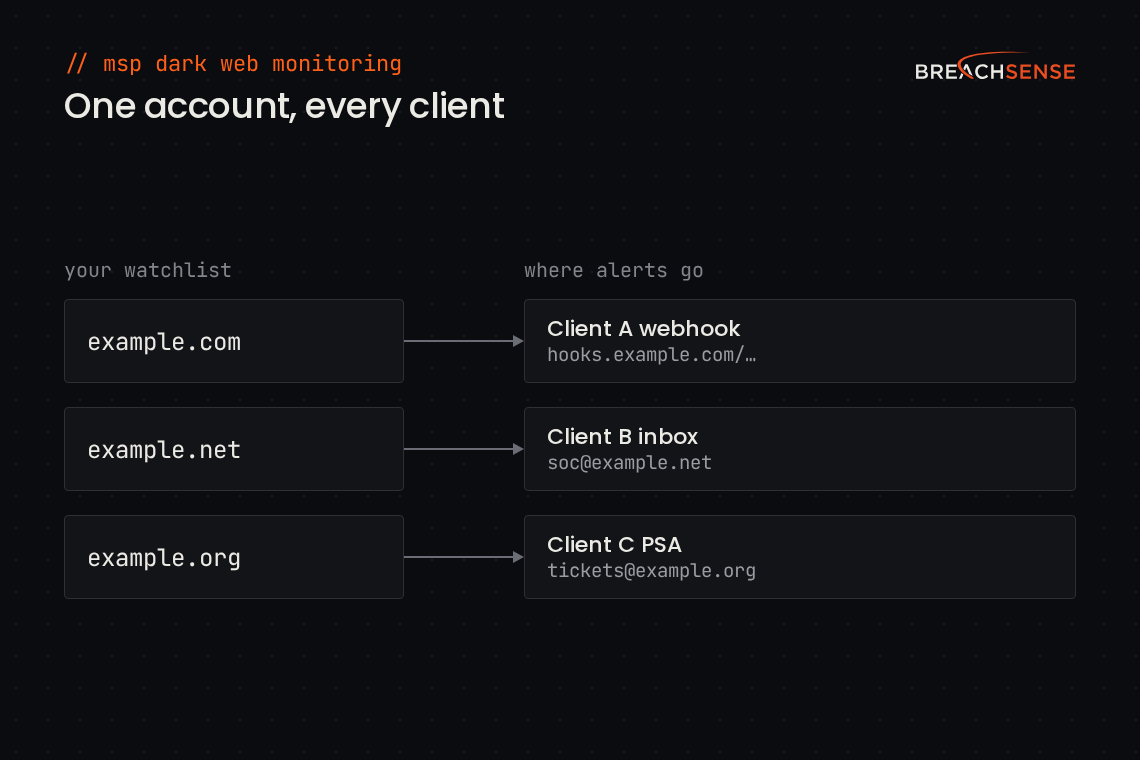
One Breachsense account covers all your clients. You add each client’s domains, email addresses and IP addresses to it. No separate instances or logins needed per customer. Most MSSPs complete onboarding in under a day.

Add every domain a client uses, including old brand domains and its Microsoft 365 domain (such as client.onmicrosoft.com). Some employees sign in to Microsoft 365 with a work email on that domain, so you need to monitor it too.

The MSSP playbook walks through onboarding a new client, from collecting domains to the first exposure report.

Diagram: one Breachsense account monitors three client domains. Each client's alerts go to that client's own webhook, inbox or PSA

Usage-Based Pricing With No Per-Seat Math

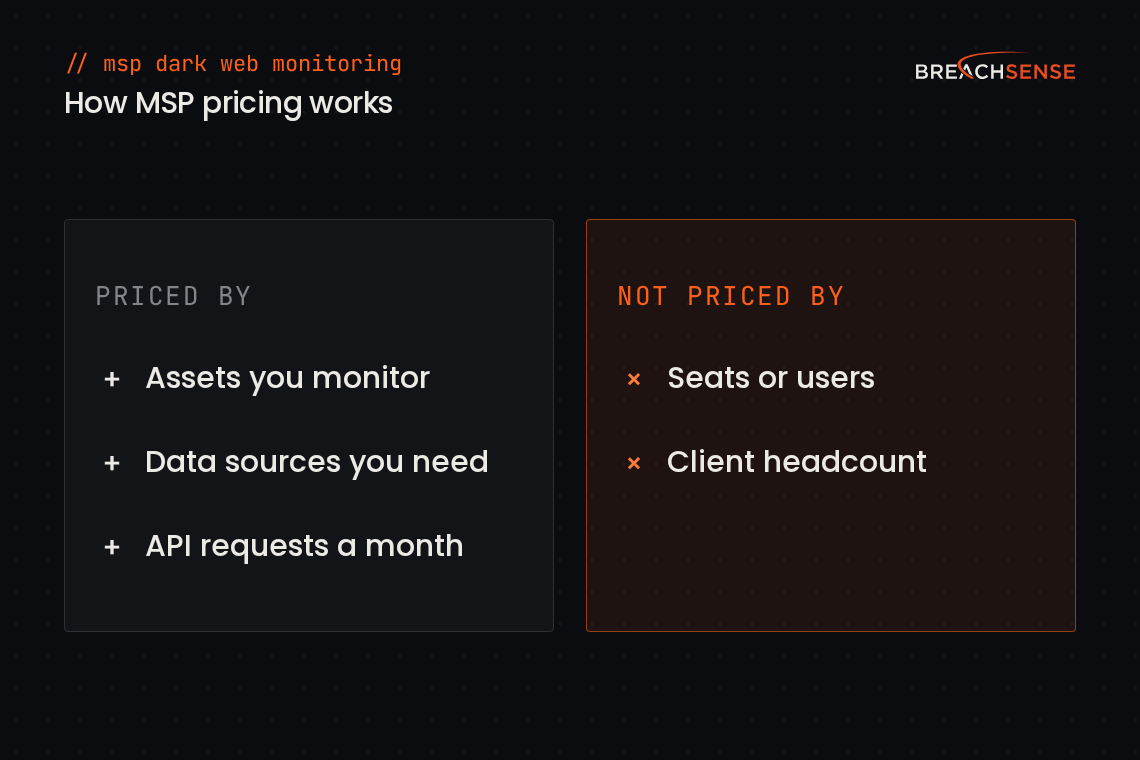
MSP pricing is based on how many assets you monitor, the data sources you need and how many API requests you send each month. On a demo call, we learn your requirements, then put together a package that covers only what you need.

We don’t charge per seat, so a client’s headcount doesn’t change your cost. You can resell Breachsense to a 5-person client or a 500-person client. A trial is available after a demo call.

How MSP pricing works: priced by assets you monitor, data sources you need and API requests a month, not by seats, users or client headcount

Send Each Client’s Alerts to Your PSA or Portal

Each watchlist entry can have its own alert address after a :: separator. For example, example.com::soc@example.com sends that domain’s alerts to soc@example.com. Each client’s alerts then go only to that client’s inbox, webhook or ticket queue.

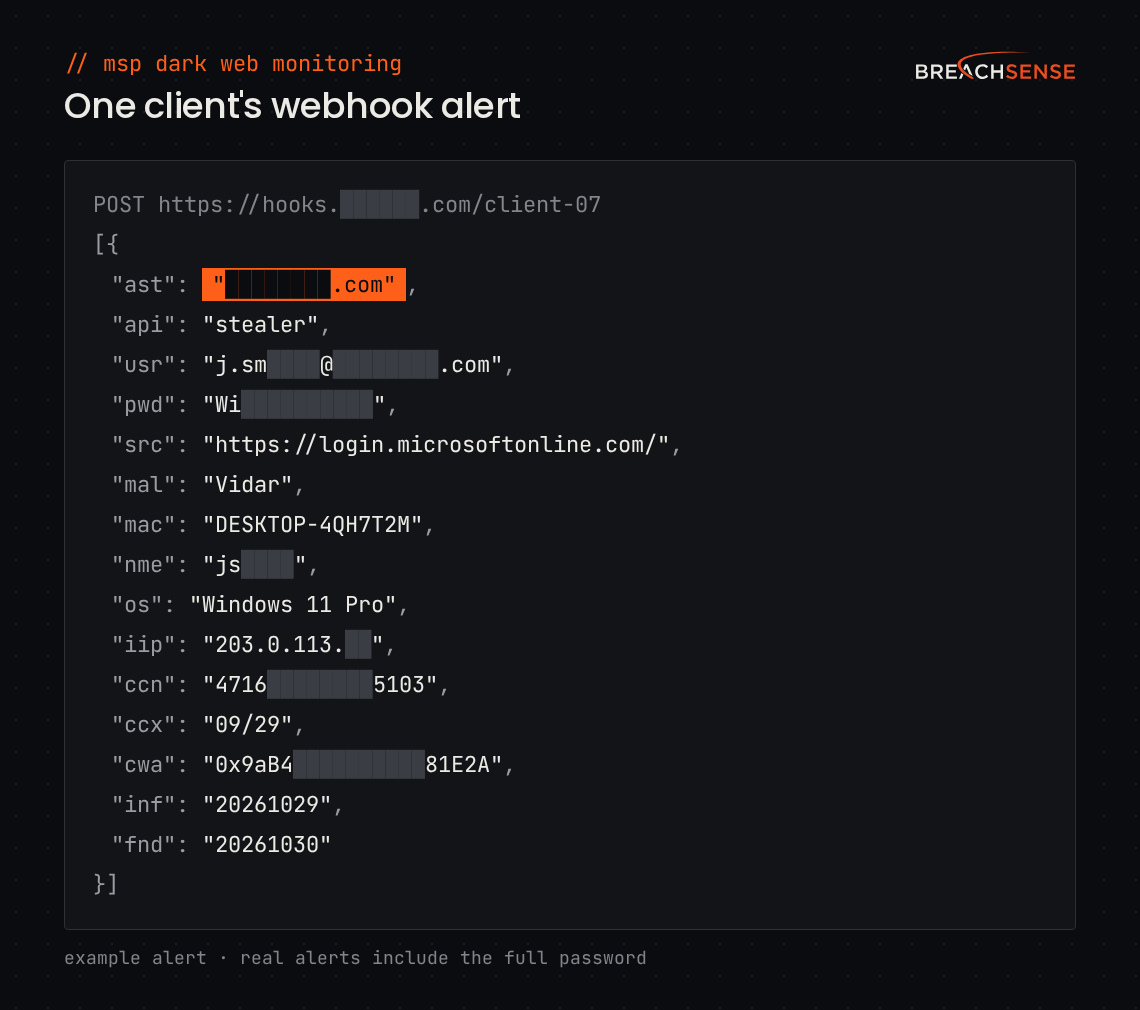
Each webhook alert is a JSON record that includes the monitored asset, so your integration layer can open a ticket on the right client’s board. You can also send alerts to your PSA (professional services automation) tool’s email intake address. The PSA then opens the ticket itself.

When a vendor that several of your clients use is breached, a short script can query each client’s domain to find which ones had data in that breach. The API documentation lists every parameter, including the :: routing syntax.

A redacted Breachsense webhook alert for one client: the monitored asset, the leaked username and password, the malware, the infected device, a card number, a crypto wallet and the dates

Demonstrate Value with Live Data

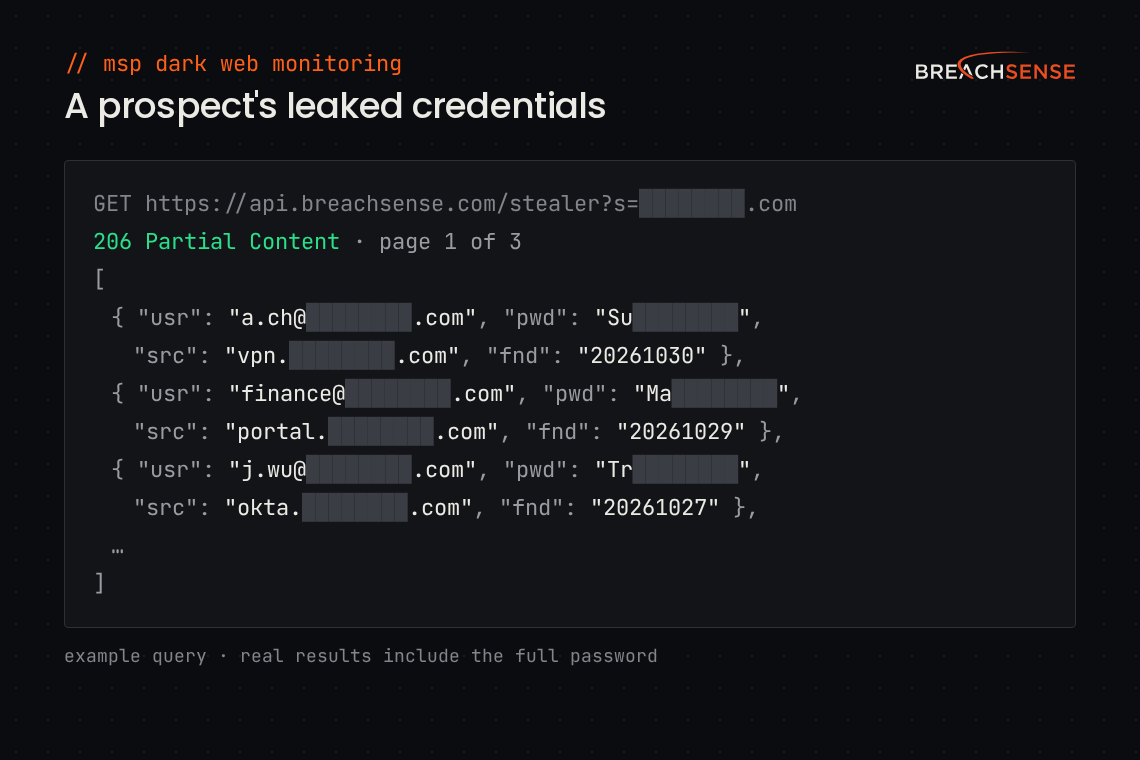
Query a prospect’s domain during a sales call to show the credentials that leaked from their company. Stealer log results include the plaintext password and, when the log records it, the infected machine’s name. The prospect’s IT team can check whether employees still use the leaked passwords and find the infected device.

For a quick first look, run our free dark web scan on the prospect’s domain to see how many employee and customer credentials have leaked. When prospects see their own data on screen, the conversation changes fast.

An API query for a prospect's domain returning leaked credentials, with usernames, passwords and domains redacted

Which Type of MSP Are You?

MSSPs use Breachsense in their SOC, MDR providers in their detection pipeline and vCISO firms in client assessments.

  • MSSP for Enterprise

    Co-managed SOC for mid-market and up

    Run a SOC for clients who already have security teams. Pull each client's leaked credentials and files from the API into your SOC dashboards and threat intel reports.

    What they use:
    High-volume APISession token detectionHacker forum coverage
  • MDR Provider

    Detection & response adding dark web coverage

    Add leaked-credential alerts to the SIEM you already run. We send each alert by webhook, so your SOAR tool can open a case automatically.

    What they use:
    SOAR webhooksAPI for case enrichmentData breach monitoring
  • vCISO / Consultancy

    Advisory firms running multiple engagements

    Pull leaked credentials and files on demand for client assessments, board reports and incident retainers. Usage-based pricing fits one-off projects.

    What they use:
    On-demand APIFull-text search across leaked dataScoped access

Breachsense vs Building It Yourself vs Reselling Consumer Tools

To add dark web monitoring, an MSP can build it, resell a consumer tool or use Breachsense.

CapabilityBreachsenseBuilding it yourselfReselling consumer tools
Per-client domain segregationIncludedYou build itVaries by vendor
Full-text search across leaked filesIncludedYou build itVaries by vendor
Infostealer log coverageIncludedYou build itVaries by vendor
API to feed your own client portalIncludedYou build itVaries by vendor
Per-client alert routingIncludedYou build itVaries by vendor
Time to integrateUnder an hourMonths of engineeringVaries by vendor
Pricing modelUsage-based, with no per-seat feesYour own servers and engineers' timePer seat

If you're replacing Dark Web ID, our Kaseya Dark Web ID alternatives page compares six replacements on data freshness and integrations.

How Does Breachsense Work for MSPs?

Add Client Domains

We Monitor the Dark Web

Get Client-Specific Alerts

Reset Credentials Fast

Frequently Asked Questions

Dark web monitoring for MSPs is a service that lets managed service providers continuously scan criminal marketplaces, forums, and leak sites for compromised data affecting multiple clients simultaneously. MSPs use dark web monitoring platforms to detect when client credentials, employee data, or sensitive documents appear on the dark web. Monitoring lets you alert clients and reset passwords before attackers use the leaked data.
MSPs use two kinds of dark web monitoring tools. The first is a console with a separate tenant for each client, where your team logs in to review alerts. The second is a data source like Breachsense, which sends each client’s alerts to your own PSA, SIEM or client portal by webhook or email. Our MSP tools comparison covers eight options of both kinds.
Yes. We sell dark web monitoring on its own, with no security awareness training bundled in. Some MSP tools sell dark web monitoring as part of a training package, so you pay for phishing simulations and courses even if you only want the monitoring.
Yes, for a basic check of whether client email addresses appear in known breaches. Have I Been Pwned (HIBP) doesn’t show the leaked password, so you can’t tell whether an employee still uses that password. We return the plaintext password when the leak contains it or we can crack the password hash. Our Have I Been Pwned alternatives page compares HIBP with tools that show the password.
MSPs monitor multiple clients through the Breachsense API. You keep a separate list of domains and email addresses for each client, and can add IP addresses too. When a client’s credentials turn up in a leak, you get a webhook or email alert for that client. MSPs can also pull alerts from the API into their own reporting tools.
Yes. You can connect our REST API to SIEM platforms, PSA tools and RMM (remote monitoring and management) systems to automate client notifications and incident response. Our dark web API lets you build custom workflows that automatically reset compromised credentials or create tickets when we find a client’s leaked credentials. Analysts can also use our skill for Claude Code, Codex or GitHub Copilot to query any client’s leaked credentials and files in plain English.
For each client, monitor leaked employee credentials and session tokens stolen by infostealer malware. A stolen session token lets an attacker sign in without the password or an MFA (multi-factor authentication) code. Also monitor leaked company files, including client data that leaks when a vendor is breached.
You can add leaked credential and session token alerts to your SOC or MDR service. Showing prospects their own leaked data during pre-sales also helps close deals. The global average cost of a data breach was $4.99 million in 2026, up 12% on the year before (IBM Cost of a Data Breach Report 2026). Catching leaked credentials early helps a client avoid that cost.

Essential MSP Security Resources

Best Dark Web Monitoring Tools for MSPs

Compare 8 dark web monitoring platforms built for MSP operations. See how each keeps clients separate, plus its API integration and pricing model.

Learn More

Kaseya Dark Web ID Alternatives

Six replacements for Kaseya Dark Web ID, compared on how fresh their data is and how you get it into your own tools.

Learn More

Dark Web Monitoring Platform

How dark web monitoring works at scale. Background for MSPs building or expanding their security services.

Learn More

Compromised Credential Monitoring

Detect leaked client credentials before attackers exploit them. Critical capability for MSPs protecting multiple organizations.

Learn More

Third-Party Cyber Risk Management

Monitor vendor and supplier breaches affecting your clients. Essential for MSPs managing supply chain security risks.

Learn More

Dark Web API Documentation

Technical documentation for integrating dark web intelligence into your MSP platform. Build automated workflows for client protection.

Learn More

Data Breach Detection Methods

Six steps for responding when you detect a breach. Useful for MSPs building out their security services.

Learn More

Cyber Threat Intelligence Software

Compare threat intelligence platforms. What separates basic monitoring from full detection coverage.

Learn More

Data Breach Monitoring

Search files leaked in ransomware attacks for your clients’ names, and get an alert when a client’s name shows up in a leaked file.

Learn More

Add Dark Web Monitoring to Your MSP Services

Book a demo